Thursday, February 25, 2010

Week 7

Group 3-California's Independence from Mexico

California's independence from Mexico began with Mexico, including California, gaining independence from Spain which occurred in 1821. In the 1820's many American and Canadian settlers began to come to Northern California which would later change the Northern California section of California. In 1846 the settlers rebelled and no longer wanted Mexican rule, this was called the Bear Flag Revolt. Northern California was then named the California Republic for a short amount of time, in the same year the Mexican-American War was declared, 1846. Military occupation of California by the United States began when John D. Sloat of the U.S. Navy sailed into Monterey Bay. After many battles in Southern California the Treaty of Cahuenga was signed by the mexicans in California in 1867 which secured American control in California. When the Treaty of Guadalupe Hidalgo was signed it ended the war and Northern California was its own territory and Southern California was territory of Mexico. In 1850 California was admitted to the U.S. as a free state.

On June 14, 1846 in Sonoma the historical Bear Flag of California was raised by the settlers which started the Bear Flag Revolt. I thought this flag would be a fun thing to find historical background on because it was raised in Sonoma so close to Santa Rosa and it was a big symbol in the beginning of the fights between Mexico and California. The Bear Flag was William Todd on a piece of cotton that he drew on. The star on the flag comes from Texas, the lone star state, and the bear represents the high amount of bears seen in California. The Bear Flag was raised at the Sonoma site until the 1906 earthquake, when it was in possession of the Society of California Pioneers. During the earthquake the flag was burnt in all the fires, and our flag that we now have comes from the ideas of this same flag.
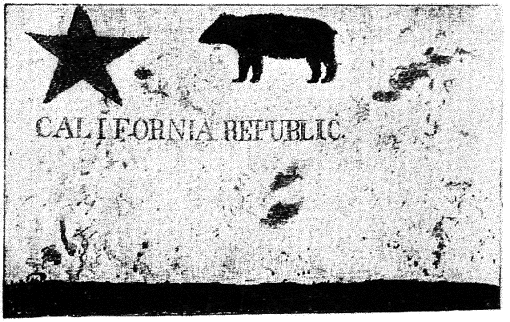
I decided to talk about the Bear Flag because I think it is a cool symbol of the time period, how it was drawn on cotton, and also cool because of the fact that it was in Sonoma which is so close to Santa Rosa.

1. William L. Todd, the creator of the bear flag, was the cousin of Mary Todd Lincoln who was the wife of the president Abraham Lincoln.
2. A replica of the flag was created in 1896 and is on display in Sonoma.
3. The flag was about a yard and a half long and the star displayed on it was red.

I think that these sources are credible because they are all well known. The wikipedia is an online encyclopedia and the other on is the official website of the SF Museum.
http://en.wikipedia.org/wiki/California
http://www.sfmuseum.org/hist6/toddflag.html
http://en.wikipedia.org/wiki/California_Republic
________________________

1. Angie-Chose to research the Metropolitan Museum of Art in New York City.
2. Brooke--Stated that the Academy of Natural Sciences is the oldest natural sciences institution in the western hemisphere
3. Eric--Learned that the exhibits on display are designed to tell the story of the war with as little bias on either side as possible.
4. Jacob--Learned that Ansel Adams has several pictures at the Museum of Contemporary Photography.
5. Jerad--Is interested in the CSI workshops that the National Museum of Crime and Punishment has.
6. Tuo--The piece of work that attracted her most was "Among the Sierra Nevada, California" by Albert Bierstadt.
7. Wes--Chose the National Civil War Museum located in Harrisburg, Pennsylvania.
8. Veronika--The wax figure that attracted her the most was the Marilyn Monroe figure.
9. Michelle--Stated that Thomas Jefferson did a lot of experimenting with plants in his garden and did selective breeding of different vegetables.
10. Mary--Visited the Smithsonian Museum of American History online in Washington D.C.


Tuesday, February 9, 2010

Week 5

Part 1
1. The name of the museum I chose is the Miami Art Museum in Florida. It contains art with influences from North and Latin America which is also why I chose it.

2. I used the museums website, youtube and wikipedia.
http://www.miamiartmuseum.org/home.asp
http://en.wikipedia.org/wiki/Miami_Art_Museum
http://www.youtube.com/watch?v=QvwoDE8w-zs

3. 1)In the background info from the museums website I learned that Miami is full of artists, designers and collectors and is in demand for a world class museum.
2)Miami is the only metropolitan area that does not have a major art museum that serves its community, and the Miami Art museum is adding on to fulfill that need.
3)The museum has a program called "MAM & Schools" for children K-12 .

4. One piece of work that attracted me from the Miami Art Museum is the piece called Regard the Class Struggle as a Main Link in the Chain by Kehinde Wiley. Wiley is know for using Harlem residence and painting them posed like paintings in art history books. In Regard the Class Struggle as a Main Link in the Chain Wiley takes this man from Harlem and positions him like the "Iron Women" who was used to promote gender equality in China's cultural revolution.

Part 2
1. Jennifer was drawn to the Getty Villa located in the Pacific Palisades because of its beautiful gardens.
2. Karen chose the museum of art and history at the McPherson center in Santa Cruz holds many different kings of exhibitions ranging from music to art to history.
3. Lori chose the exploratorium which offers hundreds of interactive science, art and human perception exhibits that are both fun for children and adults.
4. Kelpy--The Natural History Museum of Los Angeles opened in 1913.
5. Nicole--The San Francisco Museum of Modern Art was the first museum on the West Coast to be completely devoted to 20th century art.
6. Veronika--The Legion of Honor Museum contains mostly European art with the largest collection of French art.
7. Wes--The Exploratorium was founded in 1969 by a physicist and an educator by the name of Frank Oppenheimer.
8. Jacob--The Bowers Museum in Santa Ana was originally 7000 sq. ft. and is now 93,000 sq. ft.
9. Gabby--San Francisco Museum of Modern Art displays works of art by; Andy Warhol, Henry Matisse, Ansel Adams and many others.
10. Elizabeth--Loves the photographer Ansel Adams she said he is "one of the greatest print craftsmen on Earth"

Saturday, February 6, 2010

Week 4

Part 1
1.
The name of the museum that I decided to visit online is the Asian Art Museum of San Francisco.

2. I used a youtube video, wikipedia and the official website for the Asian Art Museum for my three background sites.
http://www.youtube.com/watch?v=a7zEwCtA_T0
http://en.wikipedia.org/wiki/Asian_Art_Museum_of_San_Francisco
http://www.asianart.org/

3. Three facts that I learned from the background information from my museum are:
1) The Asian Art Museum started by Avery Brundage agreeing to give his collection of Asian Art to San Francisco if they built a museum for it.
2) A matcha is a Japanese tattoo.
3) A tokonoma is an alcove in a Japanese tea room used for displaying hanging scrolls, flowers or other objects.

4. A specific piece of work in the Asian Art Museum that attracted me was Landscape with Waterfall by Huang Junbi. I liked this piece because of all the detail and I also thought it was cool how with such little color there was so much depth in the painting. This piece is categorized as a literati. A literati is a Chinese artist, like Huang Junbi that studies Art, Poetry and Calligraphy. In literati art all three of these components are incorporated into their pieces to show their talent of all three aspects.

Part 2
1. Amanda--Stated that Freier's childhood shaped his educational viewpoints.
2. Angie--Freier has had a huge influence on both new philosophical perspectives on life.
3. Ben--Stated that Freier often skipped school to play soccer with his friends and this is where he developed an understanding and connection for the less fortunate.
4. Brooke--Freier developed a teaching plan for all levels of education
5. Elizabeth--Stated that Freier's book Pedagogy of the Oppressed is one of the most quoted educational texts.
6. Eric--Said that Freier became involved in an educational movement to combat illiteracy between 1962 and 1964.
7. Gabby--Stated that in 1964 Freier was put in jail for 70 days because the government thought that his methods of literacy were causing people to want change.
8. Garin--Freire attended the University of Recife and studied philosophy and the psychology of language.
9. Jacob--What Jacob found most interesting about Freire was his experiment known as "Bare feet can also learn to read" .
10. Tuo--Stated that Freire's book Pedagogy of the Oppressed is about seeking equality and justice in the educational system.